|
THE STORY:
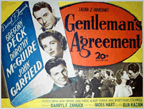
Journalist Phil Green comes to New York City with his young son and mother ready to make an impression. His first assignment...a study of anti-Semitism in America. And the only way Green can truly understand his subject is to pretend he's Jewish.
BEHIND THE SCENES:
Zanuck had his mind set on bringing Hobson's novel to the big screen even before the book went to print. To say that it was a controversial subject, made more so by the "Red Menace" hysteria and horrifying discoveries of the Nazi death camps, is a definite understatement. But it was a story that needed to be told.
I found this bit of information on the "Teach with Movies" web site: For Peck, the prejudice exposed by this film took a personal turn. People who were close to Gregory Peck pointed out that, although he is not Jewish, many "exclusive" "upper crust" clubs in the Los Angeles area, clubs that did not admit Jews, blackballed him because they felt so threatened by this film. For many years they would not permit Peck to be invited to functions at their facilities. In the sixties and afterwards these same clubs did extend invitations to Peck, but he returned the favors of the late forties and fifties and declined to attend.
THE DIRECTOR:
A young Kazan was finishing up with A Streetcar Named Desire on Broadway while the script to Agreement was being written. Kazan had won great acclaim for the 1947 hit A Tree Grows in Brooklyn.
THE BEST BUDDY:
The extremely popular John Garfield plays Dave Golden who provides a first hand account of what it's like to be Jewish. Often typecast as a tough guy, Garfield played in such films as They Made Me a Criminal, The Postman Always Rings Twice and Nobody Lives Forever. Politically and socially active, like so many other actors Garfield found himself before Congress in the late '40s and soon found it difficult to find work. Battling a long history of heart disease, he died at the young age of 39.
THE LADIES OF GENTLEMAN'S AGREEMENT:
Anne Revere brought to her role both emotional tension and comic relief. You may recognize her as "Agnes" in Keys of the Kingdom, A Place in the Sun, as well as her Oscar winning role in National Velvet. She was later blacklisted and was unable to work in the film industry for many years.
Dorothy McGuire, under contract to David O. Selznick, was almost cast as "Nora" in Keys of the Kingdom. Credits do include The Spiral Staircase, A Tree Grows in Brooklyn, Three Coins in a Fountain, Old Yeller, The Greastest Story Ever Told, and A Summer Place.
The wonderful Celeste Holm, who is still very active in stage and film and currently can be seen on TV's The Beat, was a newcomer back in 1947. She had debuted the year before in Three Little Girls in Blue. Nevertheless, her performance won her an Oscar and a Golden Globe. The Academy also nominated her for All About Eve and Come to the Stable. She even had her own TV series in 1954 called Honestly Celeste and more recently in The Promised Land.
THE AWARDS:
Despite the fact that Peck lost his third bid for an Oscar to Ronald Coleman (A Double Life), the Academy recognized Gentleman's Agreement in 8 different categories. Zanuck & 20th Century Fox received an Oscar as did Kazan and Celeste Holm. McGuire was nominated for Best Actress, Hart for his screenplay and Anne Revere was also nominated for her wonderful supporting role. The eighth nomination was for Best Editing.
The film also won major awards from the New York Film Critics Circle, the National Board of Review and the Golden Globes which also recognized Dean Stockwell for his Best Juvenile performance.
SUCCESSES AND FAILURES:
Gentleman's Agreement played for 28 weeks at the Mayfair Theater on Broadway. It went on to become Fox's top-grossing film for 1948.
While the New York Herald Tribune called the film "a brilliant blow against racial and religious intolerance...irrestistible entertainment.... Peck...and the...cast act as though they knew what they were up to and meant every minute of it...." The New Yorker countered with "...the problem...is quite a bit bigger than Mrs. Hobson and Mr. Hart make it out to be...." But as John Griggs points out in The Films of Gregory Peck, "No reasonable person would have expected Gentleman's Agreement to put an end to prejudice but it was honored probably as much for its intentions as for its excellence."
RELATED LINKS:
Elia Kazan: Postage Paid
History of Fox
|